
For decades, interiors celebrated sharpness. Clean lines. Perfect right angles. Crisp edges that photographed well and signalled control.
But in 2026, something is shifting.
Spaces are softening, not just visually, but emotionally. Walls curve. Corners dissolve. Furniture rounds itself gently into the room. Circulation flows instead of cuts.
This isn’t decoration.
It’s a response.
A response to stress culture, digital overload, and lives lived constantly on edge.
Curved stairs balustrade entry
Circulation becomes experienced, a sculptural curve that transforms movement into something slow, intentional, and almost meditative.
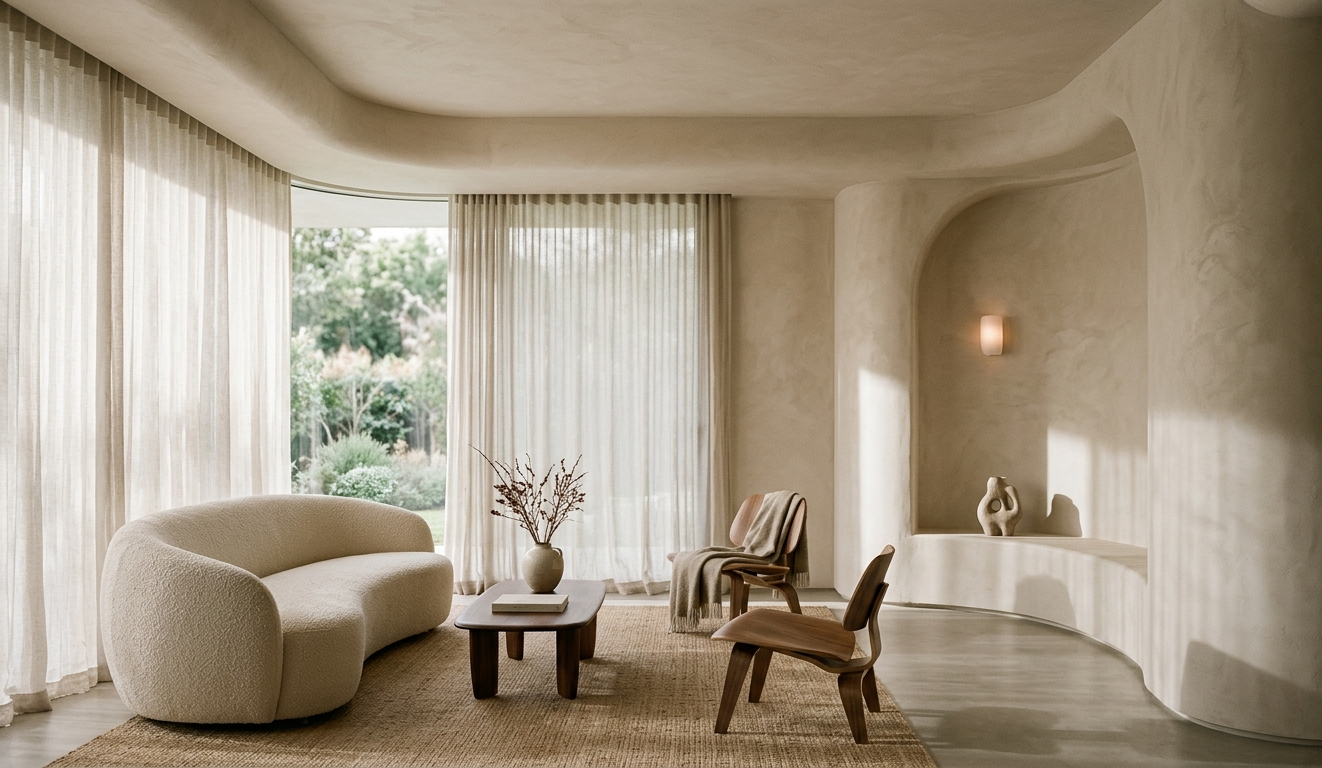
Nothing interrupts, nothing demands, organic forms and fluid edges allow the room to be felt, not just seen.
Sharp Lines Are Emotionally Exhausting
Straight lines demand attention. They divide, define, and discipline space. In moderation, they’re powerful, but when everything is sharp, the body never truly rests.
Our nervous systems don’t read rooms analytically.
They feel them.
Hard corners create micro-tension. Abrupt transitions keep us alert. Perfect symmetry can feel cold when life itself is messy and fluid.
Curves, on the other hand, signal safety. They echo the forms of nature, rivers, hills, bodies, shells. Nothing sudden. Nothing threatening.
In 2026, interiors are choosing visual comfort over visual dominance.
Curved Walls & Arched Joinery: Space That Holds You
Curved walls don’t push you through space, they guide you.
Instead of corridors that feel like channels, curved walls create moments of pause and anticipation. You don’t see everything at once. Space unfolds gently.
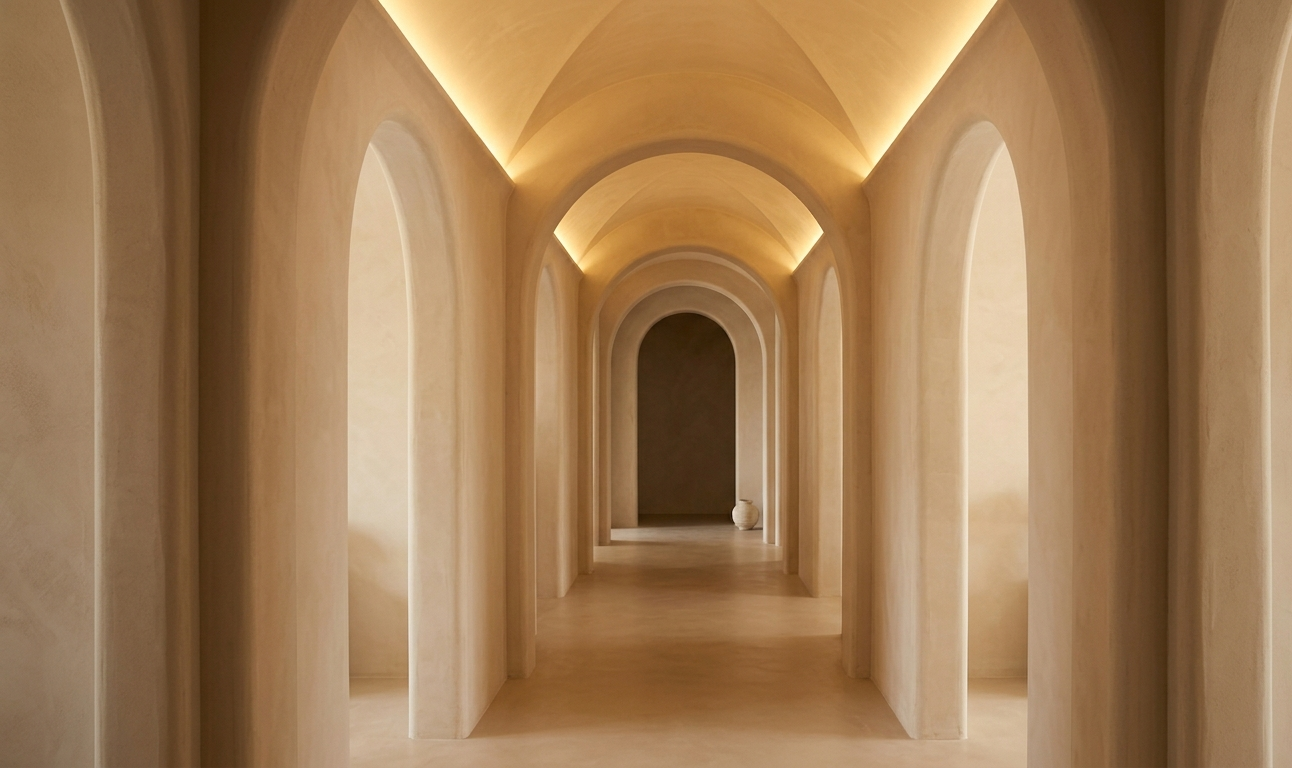
Repetition without rigidity, a rhythm of arches that guides movement gently, replacing sharp direction with calm continuity.
Arch curved hallway lights
Repetition without rigidity, a rhythm of arches that guides movement gently, replacing sharp direction with calm continuity.
Arched joinery, doorways, shelving, niches, softens thresholds. It removes the psychological stop-start feeling between rooms and replaces it with gentle transitions.
This is soft geometry at work: architecture that supports how we move and feel, not just how we look.
There’s also an intimacy to it. A curved wall doesn’t confront you — it embraces you. It holds space quietly, without demanding your attention.
Rounded Furniture Edges: Design That Relaxes Your Body
Furniture is becoming friendlier.
Tables with softened corners. Sofas that curve instead of box. Chairs that wrap rather than frame.
Rounded edges subconsciously tell us:
You can move freely here, won’t bump into resistance and this space is forgiving.
In high-stress lives, we crave environments that don’t demand constant spatial awareness. Organic form allows the body to relax – shoulders drop, posture softens, breath slows.
This is why curved furniture feels more intimate, even in large rooms. It creates micro-enclosures within open plans, small emotional zones where you can land.
Fluid Circulation: Letting Movement Flow
Curved living room minimalism-trendy
Nothing interrupts, nothing demands, organic forms and fluid edges allow the room to be felt, not just seen.
Rigid layouts tell you where to go.
Fluid circulation lets you choose.
In 2026 interiors, pathways curve naturally around furniture, walls, and light. Movement becomes intuitive rather than instructed.
You don’t feel directed, you feel invited.
Fluid circulation supports:
Calm navigation
Reduced visual noise
A sense of ease rather than efficiency
It mirrors how we want to live now – less linear, less rigid, more adaptive.
Why Curves Feel Safer and Calmer
There’s science behind it.
Humans are wired to detect threat. Sharp edges, points, and abrupt contrasts trigger alertness – a subtle but constant activation of the nervous system.
Curves do the opposite.
They signal continuity. Softness. Safety.
They allow the eye to move without interruption, and when the eye relaxes, the body follows.
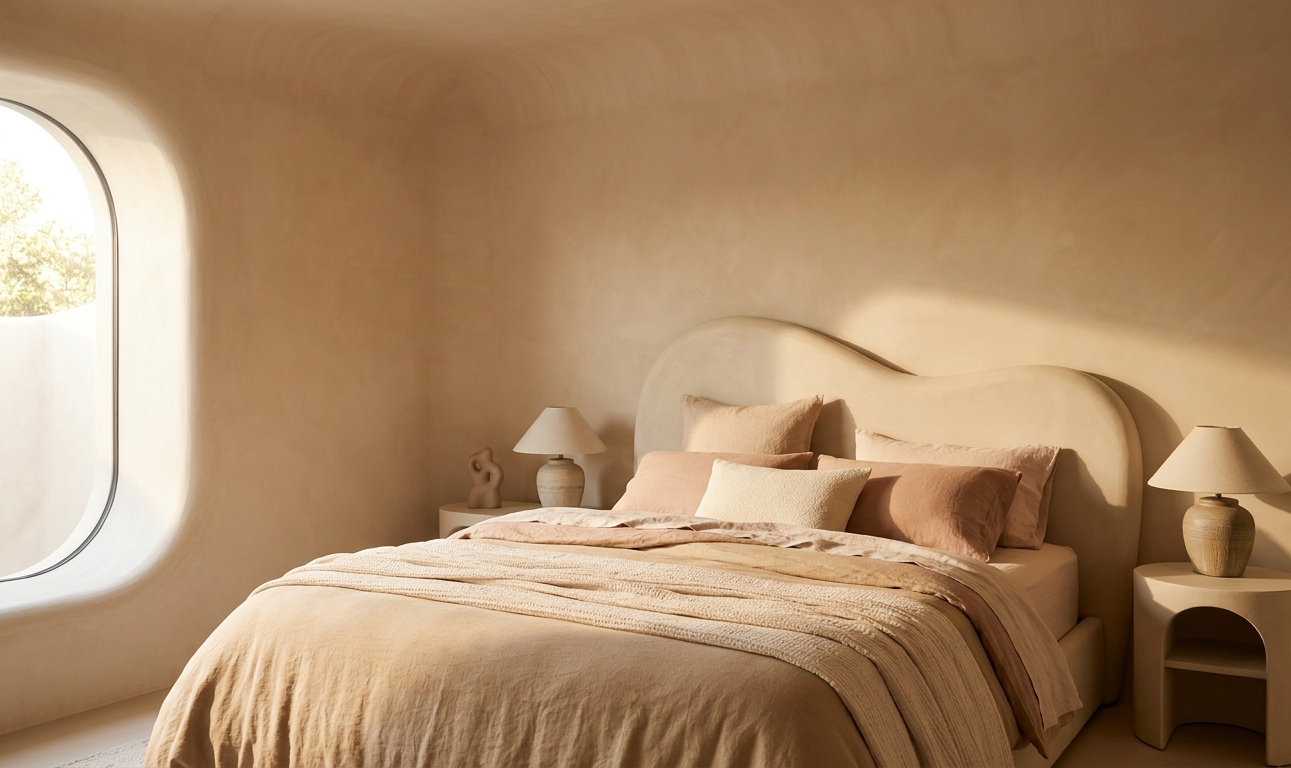
A space that holds you, not frames you, where soft geometry and warm light create a quiet sense of emotional safety.
Bedroom curved soft light
A space that holds you, not frames you, where soft geometry and warm light create a quiet sense of emotional safety.
In a world of deadlines, notifications, and endless decisions, interiors are becoming quiet refuges.
Curves don’t ask for attention.
They offer reassurance.
Why This Matters in 2026
Design is finally responding to stress culture, not by adding more stimulation, but by removing it.
The softening of space reflects a deeper cultural shift:
From performance to presence
From perfection to comfort
From control to care
This isn’t a trend you’ll grow tired of.
It’s a recalibration.
Because homes were never meant to impress the nervous system.
They were always meant to soothe it.


